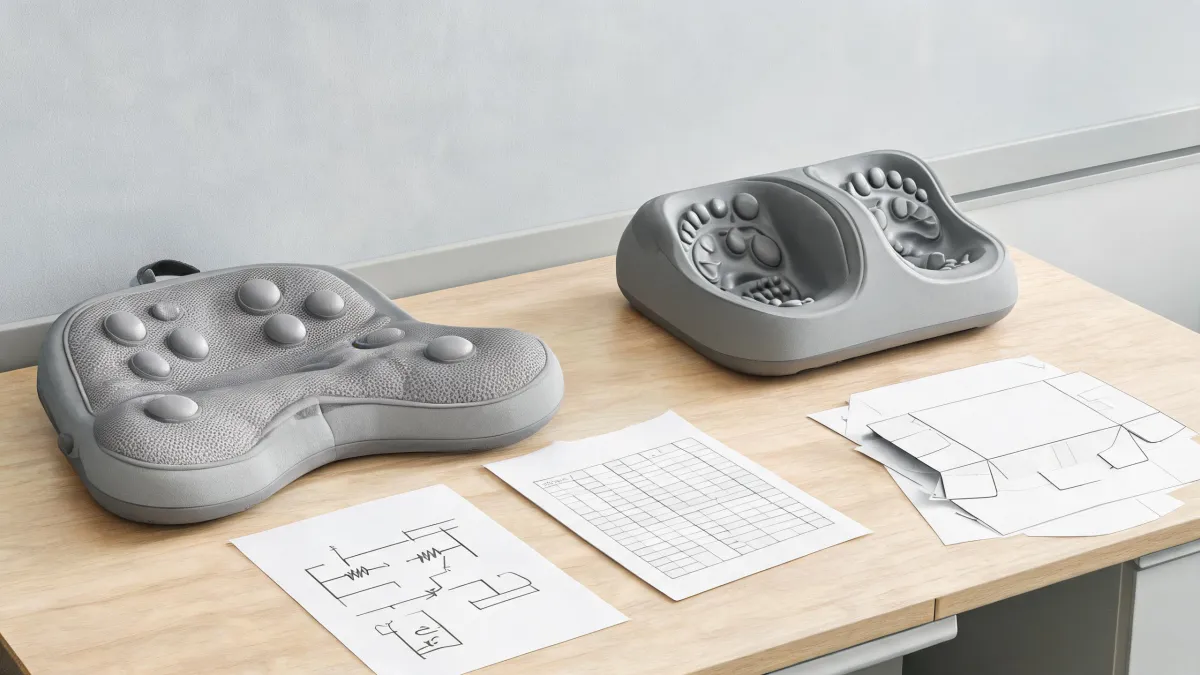
Imagine the first minute: someone unboxes the Homedics SP-25H, presses the power button, feels the mechanism start, and keeps pressing whenever the action does not match what they pictured. By the time they stop, they are in vibration only, or they have clicked the unit back off and decided it is weak. The button is not a switch you flip once while the other choices sit somewhere else on the housing.
On this model the power button walks a fixed four-step cycle: shiatsu, then vibration, then both together, then off. That is the whole control. Combination mode is the third press counted from a known off state, so the reliable move is to count to it rather than press until the sensation feels right. Everything below stays inside this one model and the manual it ships with.
Why One Press Confuses New SP-25H Owners
A single-button cycle is not a menu you scroll. Nothing on the outside of the unit lists shiatsu, vibration and combination as separate entries waiting to be picked. Each press moves the state forward one step and the fourth brings it back to off, which means every press is a commitment rather than a nudge. The only route back to a state you passed is to keep going around the cycle.
The reason new owners get lost is that they judge by feel instead of by count. The shiatsu action and the vibration feel different from each other, and both together feel different again, but the first and third press both start movement. Someone pressing twice in quick succession can end up somewhere unintended with no idea which step they are on.
The consequence is rarely a broken unit. It is a wrong conclusion. A buyer lands in vibration only, decides the massage is weak, and either returns the machine or leaves it in a closet. The control did exactly what it was built to do and the owner never saw the mode they paid for.
The Four-Press Order on the SP-25H
From off, the first press turns the massage pillow on and activates shiatsu massage. A second press switches to vibration massage. A third press runs shiatsu and vibration together. A fourth press turns the unit off. There is nothing else to select.
The part people miss is where the count starts. Because the button cycles states instead of exposing them as labeled controls, off is the only reference point you can confirm without guessing. Counting from off gives each mode a fixed address: one is shiatsu, two is vibration, three is both, four is stop. Counting from anywhere else is a guess wearing the clothes of a mode, and that guess is what drops people into the wrong state.
That is also why a quick double-tap feels natural and works badly. The button responds to every press, so the second press of an impatient pair lands you in vibration when you meant to stay in shiatsu.
How to Confirm You Reached Combination Mode
Suppose you are a few minutes in and cannot remember whether you pressed twice or three times. The cycle hands you a reset that does not depend on memory: press until the unit stops and you are back at the documented off state, then count up again. It costs a few seconds and removes the ambiguity entirely.
At the third press, confirmation is simple once you know what to expect. Both actions run at the same time, so the unit is doing shiatsu and vibration together rather than one or the other. Feel only one kind of action and you are on press one or press two. Which means the check is not whether the sensation seems right, but whether you are on the third step, and the count answers that.
One habit keeps this clean over weeks of use. Treat the count as part of the session rather than something you reconstruct afterwards, so the running state never drifts into whatever you pressed last.
Why Heat Waits for a Massage Mode
Heat on the SP-25H will not work unless the massage function is activated. That is a condition, not a quirk: the manual ties heat to the massage state, so there is no documented way to run warmth on an idle unit. Activate a massage mode and heat has something to attach to.
The practical translation is an order of operations. If warmth is part of the session, pick a massage mode first and let heat follow it. If what you actually want is a warm pad on a switched-off device, this is the wrong product for that, and no amount of button work changes it. What heat adds beyond the massage modes is not something the manual quantifies, so treat warmth as a feature of the session rather than a measured dose of anything.
Imagine a shopper who wants warmth for a stiff lower back during a TV episode and assumes heat is a push-and-go function. On this model the assumption fails on the first evening, because the heat condition sits behind the massage step. Knowing the order in advance turns that into an expected step instead of a defect report.
What the 15-Minute Shutoff Means for a Session
There is a 15-minute auto shut-off on the massaging mechanism. That single number shapes a session more than any other detail, because the massage ends on a timer rather than when you decide to stop.
Imagine settling in for a long film with the massager behind your neck. Fifteen minutes in, the mechanism stops. Nothing is broken; the timed block has finished. Which means you should plan around one block instead of assuming the unit runs as long as you leave it switched on. Anyone expecting continuous operation reads that stop as a fault the first time it happens.
The upside of a timer is predictability. You know the length of a block before you begin, so you can decide in advance whether one block is the session. What the manual describes is a timed block, not an open-ended run, so build expectations on the documented block rather than on how long you feel like sitting there.
A First Session, Start to Finish
Set the count at zero with the unit off. Give the first press time to register before you decide anything, because a second press a few seconds later is exactly how the count gets lost in the first place.
Move through the states in order rather than jumping. If you want both actions, you are working up to the combined state, and there is no shortcut that skips the ones before it. Heat, if it is part of the plan, comes after a massage mode is running, not before it.
Two ways to finish. Press a fourth time and you turn the unit off on your own schedule. Leave the controls alone and the 15-minute auto shut-off ends the massaging mechanism for you. Either way the block has an end.
The documented flow is modes in a fixed order, heat tied to a massage mode, and a timer that closes the block. There is no separate selector in that sequence to hunt for. On this model your decision is which of the three running states you want and whether one block is enough.
The One Check Before You Order
Before you buy, confirm that the listing or the manual names the SP-25H and describes the same four-step power-button cycle, with combination sitting at the third press. That is the check worth two minutes, and it matters because the control layout is model-specific. Shiatsu massagers look alike from one listing to the next and do not share button logic.
If the page describes a different order, or lists separate mode buttons, do not assume this behavior carries over. You would be buying one control scheme and pressing it the way this one works. Two listings can show the same silhouette and hide different manuals inside, and the sequence is the part you are actually checking.
