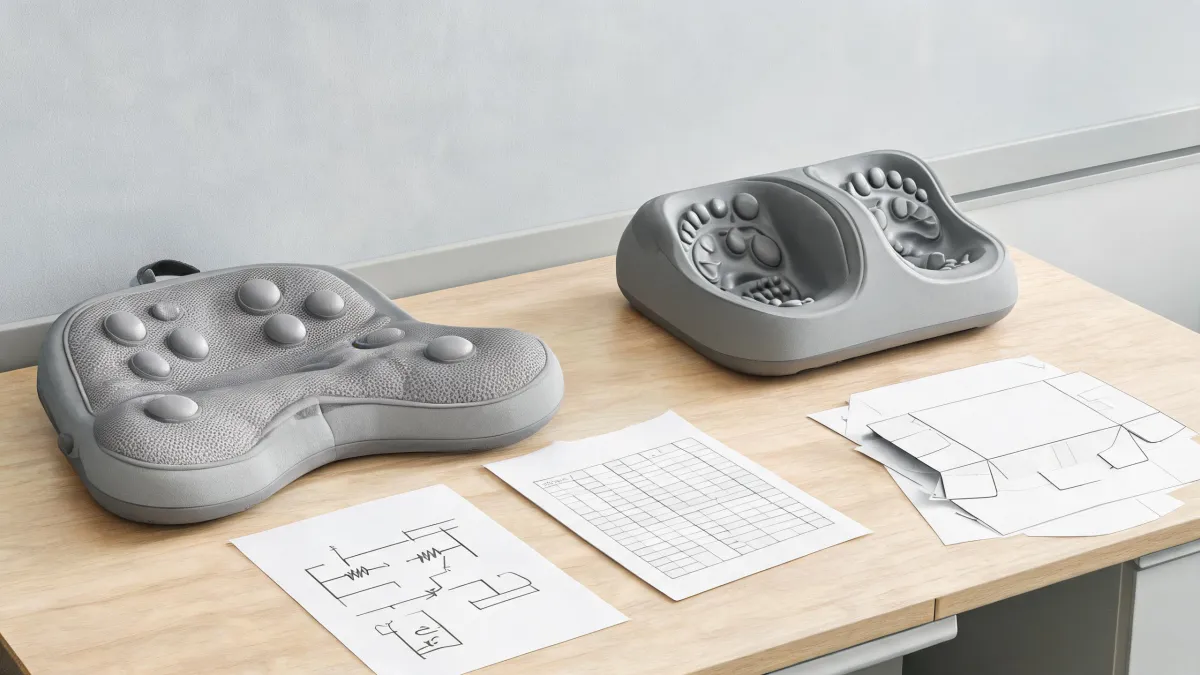
On the Homedics SP-25H, circular kneading describes one physical thing: a massage head that turns in a circle while working a single spot on your body. That wording comes from the unit's own manual, and it is a motion description — not a claim about depth, relief, or how closely the head imitates a therapist's hands. It binds to this model and the manual revision on file, and the same sheet says in a separate sentence that the product is not intended for medical use.
Treat the phrase as a usage parameter on the buying checklist, beside the other mechanical details on the spec panel. What it does not settle is who uses the unit, for how long, and whether it suits a given person — those are separate questions with separate answers.
What the SP-25H Manual Means by Circular Kneading
The manual does the defining in two sentences that do different work. One is general: "Shiatsu is a deep kneading circular massage." The other is about the hardware: "This unit features a spot Shiatsu massage mechanism that works a specific area of your body." Read together, they give two checkable facts. The action is circular kneading, so the head turns rather than taps or buzzes. The footprint is a spot, one area at a time, chosen by where you place the unit rather than a sweep down the length of your back.
The word deep sits in the first sentence with no number, force rating, or standard behind it. Nothing on the sheet says how much pressure reaches your back or what deep would measure against, so treat it as a tone word rather than a specification.
Both facts hold for the SP-25H and the manual revision captured here. A different model in the same family, or another brand's shiatsu mechanism, can use identical words for a different head design: check that unit's own sheet before carrying these two facts across.
The Setup Sequence I'd Run Before Anyone Uses It
When a shop or waiting room takes delivery of one, I would run a document check rather than a device check. Match the model number on the housing to the model on the manual cover, since a mismatch is the usual reason a procedure gets followed on the wrong machine. Read the intended-use sentence to whoever will operate it, because that sentence caps what you can promise a customer. Then find the manual's own description of the working area, so the operator knows the head is meant to sit on one spot.
The rest of the list is questions, not steps. Who should not use it, how long a session runs, which areas to keep clear, what should make you stop — those live in the manual text, and this reading turned up no step-by-step procedure and no parameter values to hand you. I won't invent a routine with numbers attached. Write the four questions down, take them to the manual that ships in the box, and follow whatever that model's text says about duration, placement, and stopping. If the manual is silent on one of them, ask the manufacturer rather than improvising.
Spot Kneading vs. Vibration and Full-Back Units
Three mechanisms get compared under one label, and the difference is mechanical. A vibration unit shakes a pad at high frequency; the contact point stays put and the motion reciprocates, with no rotating travel. A traveling back massager carries its mechanism along a track, so coverage is broad and the head is somewhere new every few seconds. The SP-25H is a spot mechanism working a single area, which is a third pattern: rotation at a fixed point, with the user deciding where that point lands.
Nothing there ranks the three. Rotation isn't better than vibration, and local isn't better than broad; they ask different things of the person using them. Someone who wants to lean back on a cushion and feel a general buzz across the shoulders is served by a vibration pad with no positioning involved. Someone who wants a head that keeps working one spot while they press into it matches the circular mechanism. Both are statements about motion; neither measures how the thing feels on a given back.
Three Buyers, Three Readings of the Same Phrase
Consider three shoppers reading the same product page. The first sits at a desk all day and wants one stubborn spot between the shoulder blades worked over; the useful half of the phrase for her is "spot" and "a specific area," because it tells her she will be positioning the unit rather than lying under a full-back track. The second runs a small studio and is outfitting a waiting area. For her the phrase is a spec-sheet detail, and the honest line item is a comfort buy, not a treatment plan.
The third is buying for an older parent and reads deep as a quality signal. Deep doesn't mean better — the sheet used an adjective where a measurement could have gone, and how much pressure a body tolerates is personal. Each of these three is a hypothetical shopper, not someone I watched buy; the point is that one sentence splits into three different purchase questions depending on who is holding it.
What I Noticed Reading the SP-25H Sheet
Reading the SP-25H sheet cold, the first thing I noticed was the order: the manual defines shiatsu in the abstract, then describes what this unit's mechanism does. That sequence matters when you check a claim, because the general sentence is the one a product page quotes and the mechanical sentence is the one that tells you what you bought.
I found the non-medical line set off in its own sentence, doing separate work from the feature description instead of hiding inside it. I also noticed the feature sentence says "a specific area" and stops, with no coverage claim for the whole back and no list of body parts.
What I did not find in the material I worked from is just as useful: no session length, no force rating, no troubleshooting figures. When a buyer asks me how long to run it, I hand the question back to the manual in their box, because I have no sourced figure and won't manufacture one.
What Circular Kneading Does Not Promise
The manual draws a line and doesn't blur it: "This product is not intended for medical use. It is intended only to provide a luxurious massage." That is why the mechanism description shouldn't be read as a therapy claim. A rotating head on one spot is a massage, not a treatment for a diagnosed condition, and the sheet suggests nothing of the kind.
The wider picture on massage as practiced: the NIH's National Center for Complementary and Integrative Health describes the risk of harmful effects as appearing low, while noting rare reports of serious side effects — blood clot, nerve injury, bone fracture — some involving vigorous types of massage such as deep tissue work, some involving people at higher injury risk, older adults among them. That is a category-level statement about massage, not a study of this device, and it shows neither benefit nor harm for the SP-25H. So the personal questions — is this appropriate for this person, should a clinician be asked first — don't get settled at checkout.
Back to the shopper holding the product page beside the manual. If she needs a head that turns against one spot while she leans into it, the phrase has done its job and the SP-25H earns a place on the shortlist. Session length, who in the house should clear it with a doctor, and how her own body responds are questions the sentence cannot answer and the manual and a clinician can. Buy it to make a break more comfortable, not as a plan of care.
